
Authentication answers one important question: is this the right credential?
But modern digital risk increasingly asks a harder question: is the right human still present, still in control, and still acting with enough assurance for this specific moment?
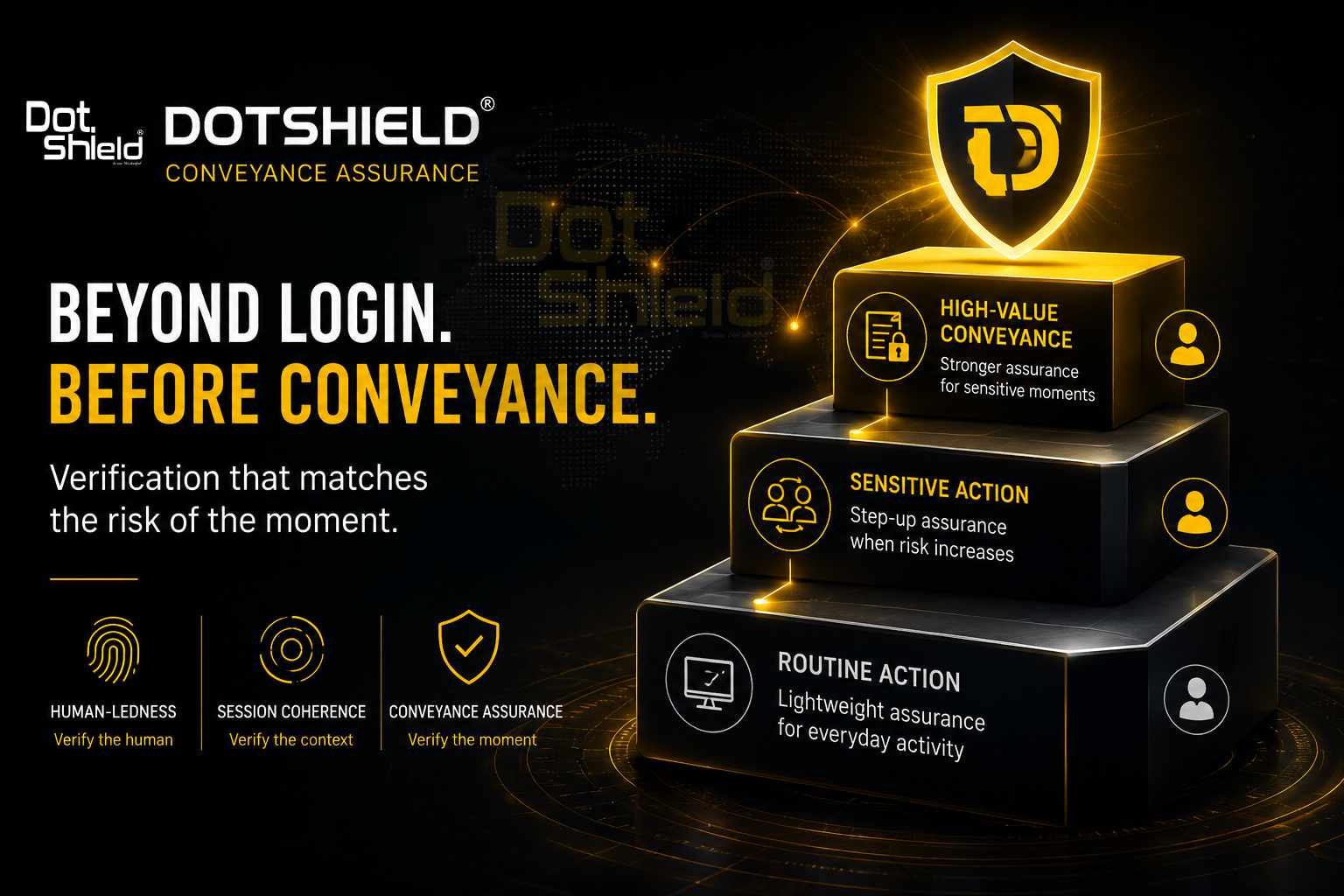
Everyday interactions should stay light, fast, and low-friction.
Riskier actions should receive stronger assurance before they proceed.
The release of funds, documents, or private records deserves a higher bar.
Login trust is often stretched too far.
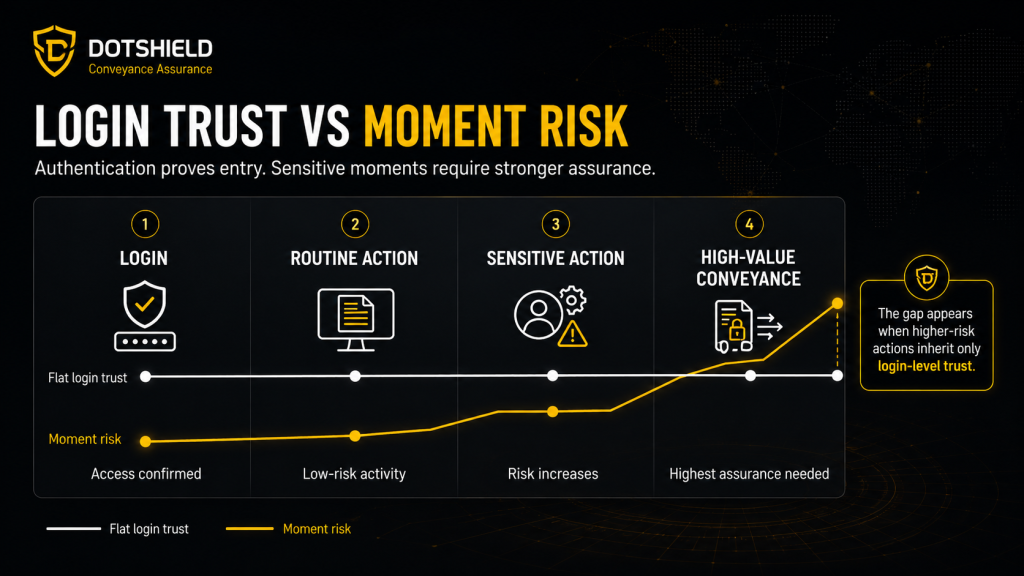
Most verification systems operate at one flat level. Once a user has logged in, the session is often treated as trusted, even when the next action carries far greater risk than the first.
Viewing a statement, changing personal details, adding a beneficiary, approving a payment, or retrieving a sensitive document may all inherit the same login trust. That creates a gap between who entered and whether this moment should proceed.
A user may be authenticated, but no longer fully in control of the session. They may be coached, coerced, socially engineered, or operating inside a compromised environment. They may still have the correct password, the correct phone, and the correct one-time code — but the moment itself may no longer be safe.
Verification should scale with what is actually at stake.
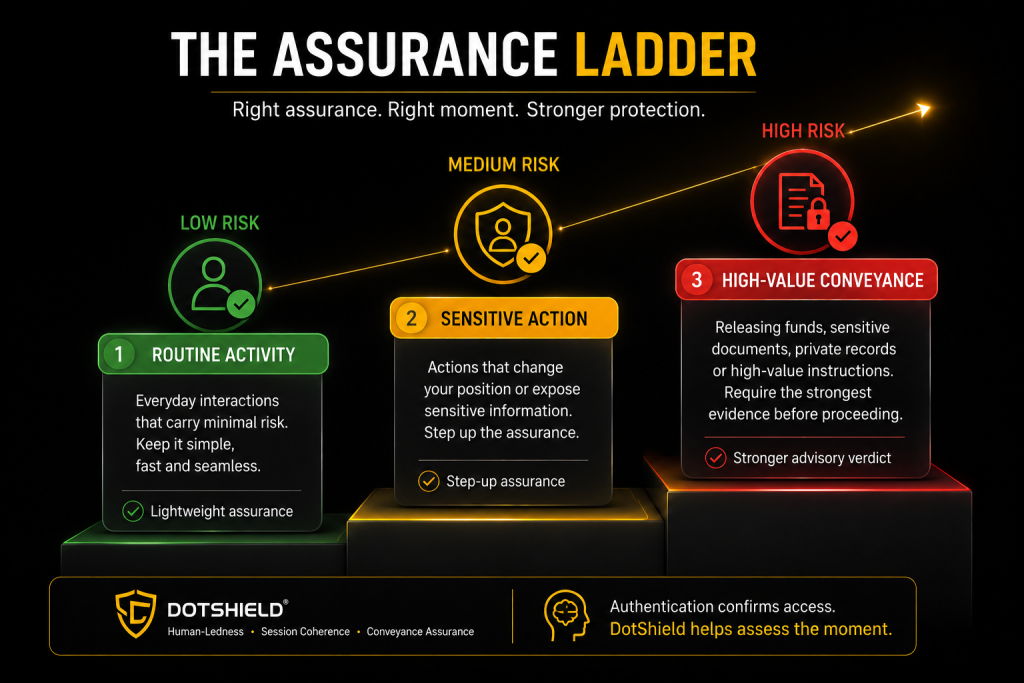
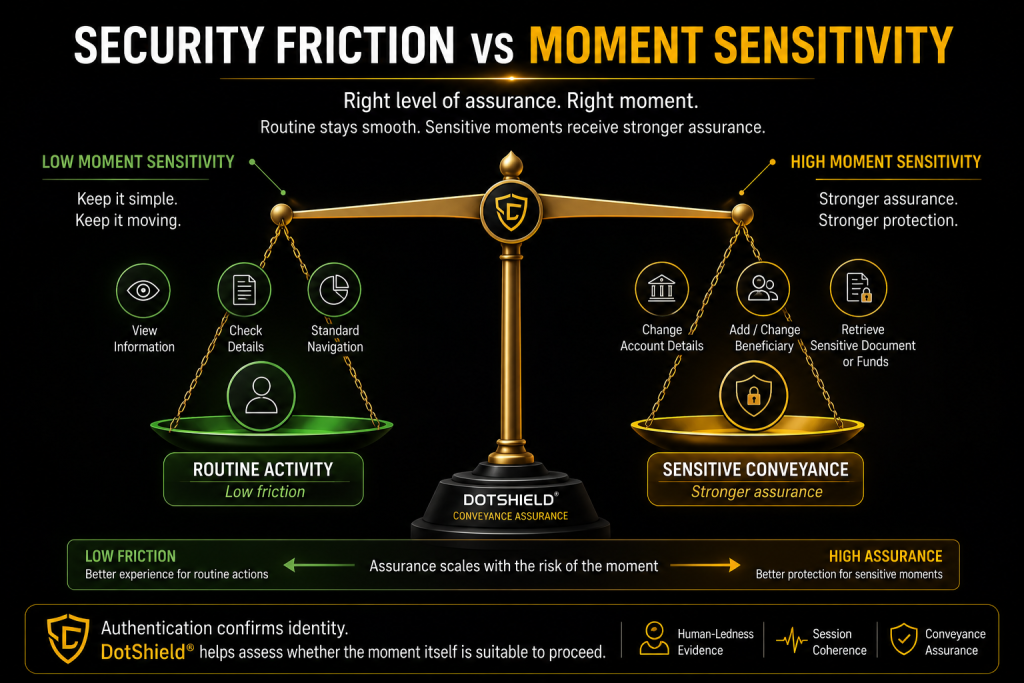
At DotShield®, the principle is simple: ordinary moments should stay light, while high-value moments should receive stronger assurance. The customer should not be forced through maximum friction for every interaction. The level of verification should rise only when the risk of the action rises.
Routine activity
Low-friction assurance
Everyday interactions should remain smooth. Reading general information, checking low-risk details, or navigating a normal session should not feel like a security interrogation.
Sensitive action
Step-up assurance
When the action becomes more important, the assurance level should rise. Changes to account details, beneficiary instructions, or document access should be treated differently from routine browsing.
High-value conveyance
Stronger advisory verdict
When funds, sensitive documents, private records, or high-value instructions are involved, the organisation should have stronger evidence before deciding whether the moment should proceed.
A password, code, or device should not be the whole decision.
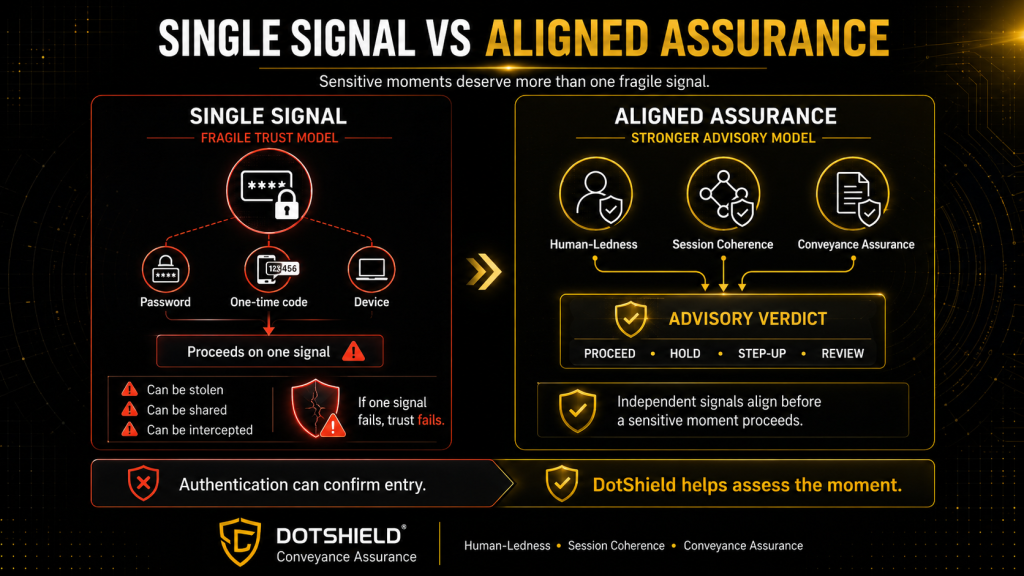
Passwords can be stolen. One-time codes can be shared. Devices can be compromised. Sessions can be hijacked. A customer can also be manipulated into approving something they do not fully understand. These controls still matter — but for sensitive conveyance, they should not be the only basis for trust.
Possession proves too much
Many systems treat possession of the right credential, phone, or one-time code as enough to continue. That may be acceptable for routine activity, but it becomes fragile when the next action is high-value or sensitive.
- Correct credential
- Correct device
- Correct code
The moment needs assurance
DotShield® is designed around a different principle: sensitive moments should be supported by multiple forms of assurance, so no single password, code, device, or message becomes the entire release decision.
- Human-Ledness evidence
- Session coherence assessment
- Conveyance-assurance verdict
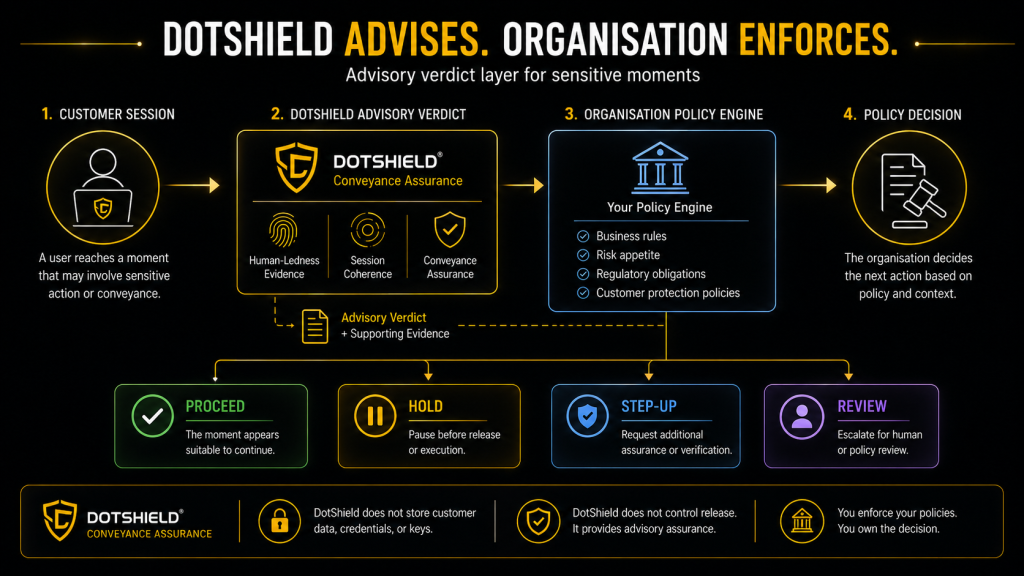
DotShield advises. Your organisation enforces.
DotShield® does not replace an organisation’s authentication system, policy engine, or release authority. It does not hold the organisation’s keys or directly control customer data. Instead, DotShield supplies an advisory verdict and supporting evidence that the organisation’s own systems can consult before a sensitive moment proceeds.
Customer session
A user reaches a moment that may involve sensitive action or conveyance.
DotShield assessment
Human-Ledness, session coherence, and conveyance assurance are assessed.
Policy decision
The organisation’s own policy engine decides the next action.
Stronger assurance should appear only where it earns its place.
A well-designed security system should not punish every customer with maximum friction. It should understand context. Some moments should pass quietly. Some should receive a light check. Some should require materially stronger assurance before the organisation allows the action to continue.
Better for customers
Customers doing ordinary things should not feel interrogated at every step. Tiered assurance keeps routine activity smooth, while adding protection only when the action becomes sensitive enough to justify it.
Better for organisations
Organisations gain a clearer way to distinguish routine access from sensitive conveyance. Instead of treating every authenticated session the same, they can apply policy decisions based on the risk of the moment.
The future of digital trust is not only stronger login. It is stronger decisioning at the moment of risk.
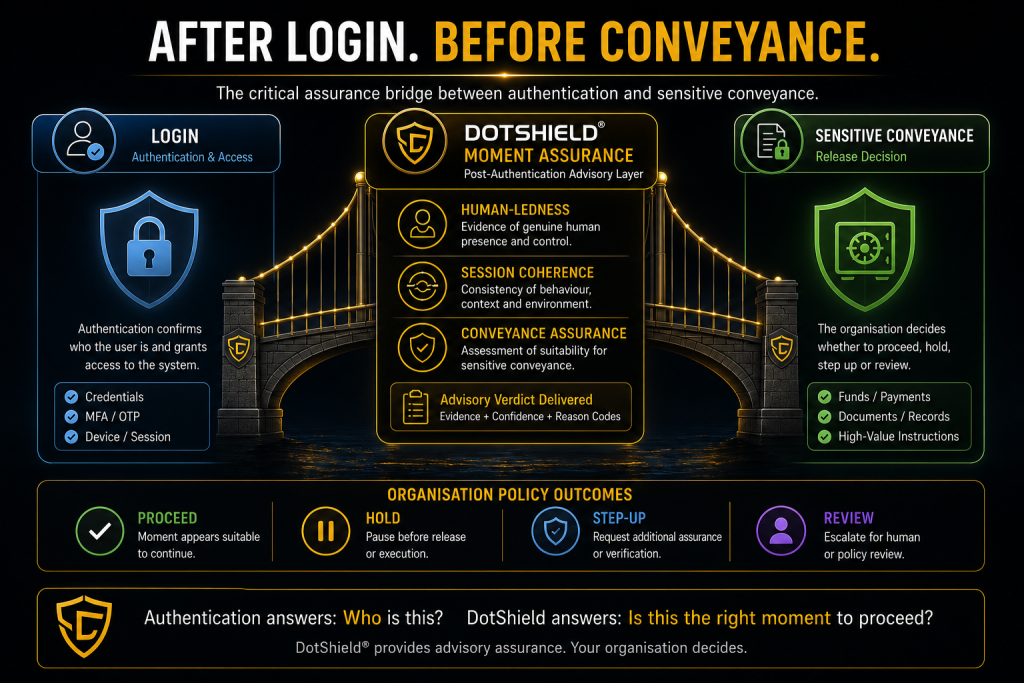
DotShield® is being built around post-authentication conveyance assurance: the layer between login and the release of something that matters. The focus is not only whether a credential was correct. The focus is whether the moment is human-led, coherent, and suitable for sensitive conveyance.
Login
Authentication confirms access and establishes the session.
Moment assurance
DotShield helps assess Human-Ledness, coherence, and conveyance suitability.
Sensitive conveyance
The organisation decides whether to proceed, hold, step up, or review.
Digital trust is moving beyond login.
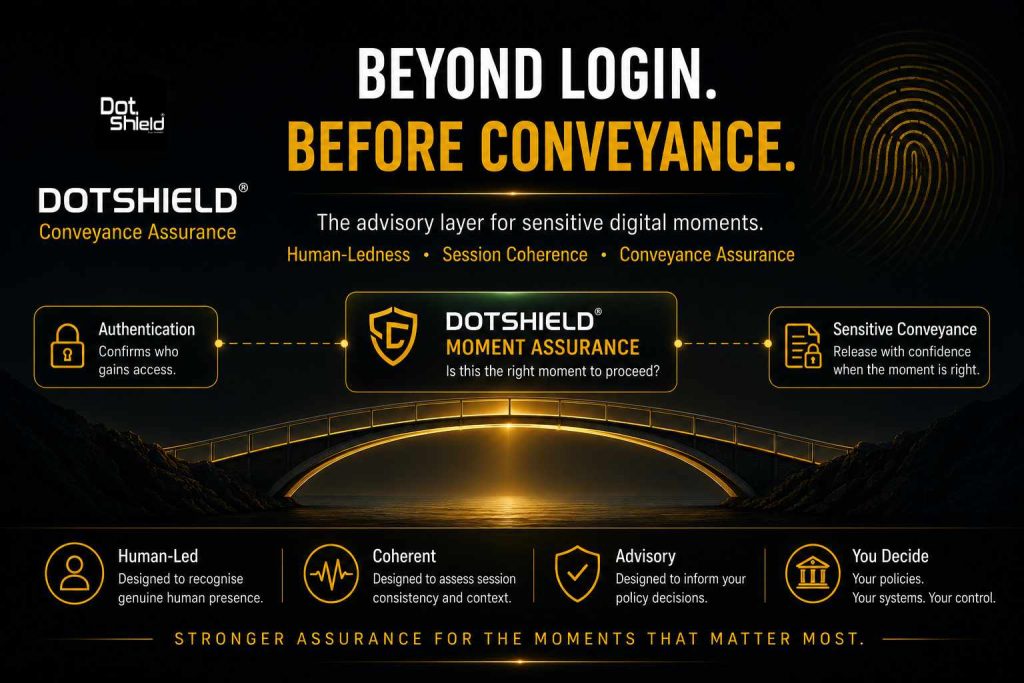
Strong authentication remains important. But the next layer of protection is not only about proving who entered the system. It is about helping organisations assess whether a sensitive action is still human-led, coherent, and suitable to proceed at the moment it matters.
DotShield® is designed for that post-authentication gap: the space between access being granted and something valuable being released, changed, retrieved, or conveyed.
DotShield helps assess: is this the right moment to proceed?
DotShield® is a registered trademark of GABEY Consulting Pty Ltd. Networthy™, ConveyanceShield™, Human-Ledness™, and related names, marks, graphics, diagrams, wording, and product positioning are used as trademarks of GABEY Consulting Pty Ltd unless otherwise stated. This article describes public category positioning only. Technical mechanisms, protocol details, ceremony designs, token models, control logic, and implementation methods are intentionally omitted and remain confidential pending applicable IP review.