
Verified source: GABEY Consulting Pty Ltd · gabey.com.au
How DotShield ConveyanceShield works
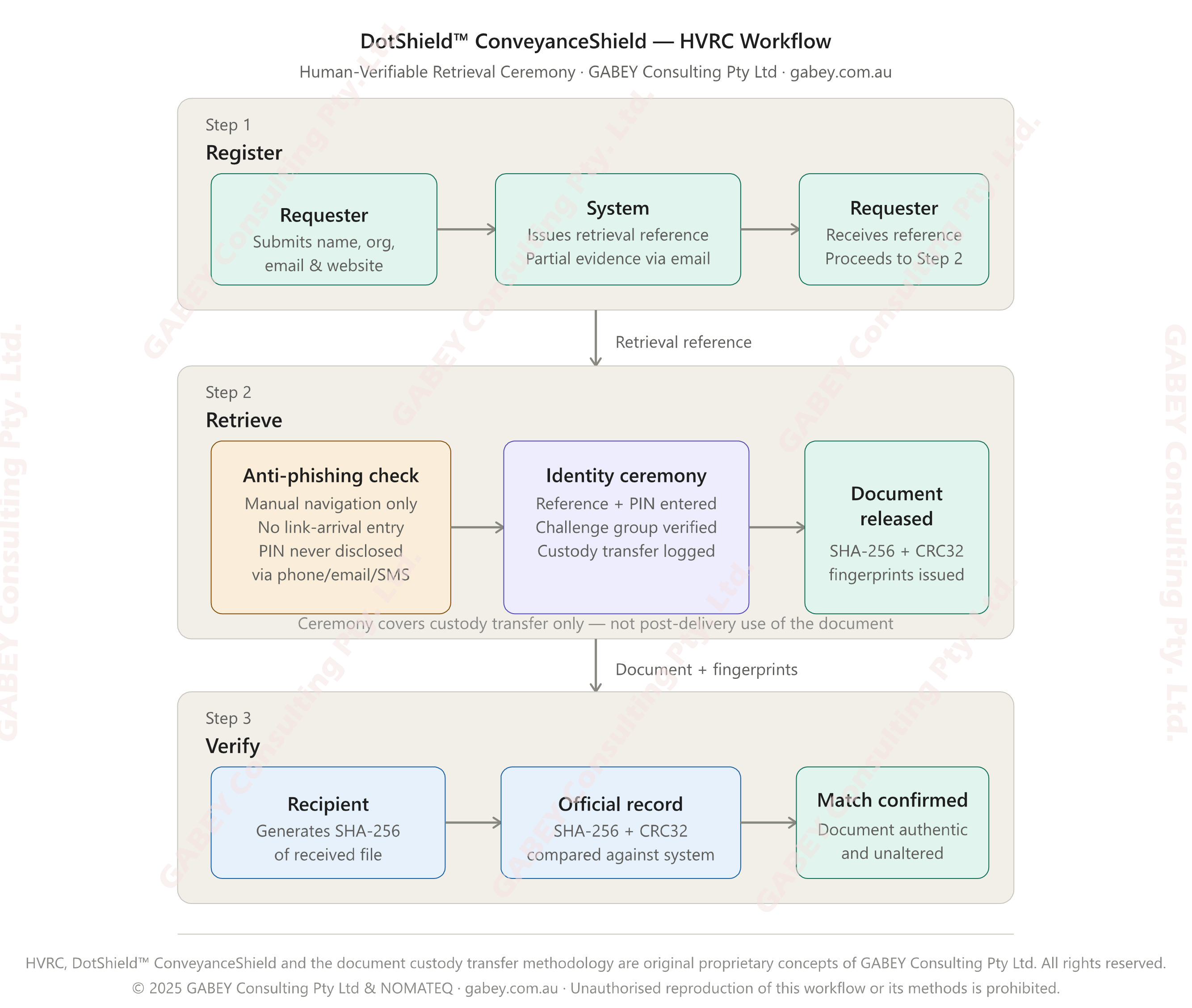
ConveyanceShield uses a Human-Verifiable Retrieval Ceremony (HVRC) to deliver documents with a verified, logged chain of custody without relying on email as the document delivery channel.
How to verify this HVRC ceremony is genuine
- The address must begin with https://gabey.com.au/.
- The document is never attached to the email.
- The email only contains partial retrieval evidence.
- The one-time PIN is shown only on the registration page.
- The retrieval page must display the same remembered ceremony phrase.
- The downloaded document can be checked using the official SHA-256 and CRC32 values.
- This HVRC demo does not require payment, banking details, card details, identity documents, or account passwords.
The retrieval process — step by step
Register your details
The requester submits their full name, organisation, and email address. This creates a verified request context tied to the document. No document is transferred at this stage.
Requester actionReceive partial evidence by email
The system sends a confirmation email containing partial retrieval evidence only. The document is not attached, and the email alone is insufficient to retrieve the document.
System actionKeep your PIN from the registration page
A one-time PIN is displayed on the registration page. It is not sent by email, SMS, or chat. If the email is intercepted, it still cannot be used alone to retrieve the document.
Requester recordsRetrieve through the ceremony
The requester manually navigates to the official retrieval page, enters the emailed groups and the PIN, confirms the registration phrase, and completes a short-lived human challenge before the document is released.
CeremonyVerify the downloaded document
The recipient generates the SHA-256 hash of the downloaded file and compares it with the official verification page. A match confirms the received file aligns with the official record.
Enterprise capability tiers
ConveyanceShield can be deployed in staged capability tiers. Higher tiers extend the same verified custody model with stronger encryption, retention, and client-side control.
Standard
ConveyanceShield
Verified HVRC delivery for organisations requiring documented chain of custody.
- Human-verifiable retrieval ceremony
- SHA-256 and CRC32 integrity
- Anti-phishing ceremony controls
- Custody transfer logging
- Partial evidence email model
- International access supported
Enhanced
ConveyanceShield+
Adds encrypted client details and encrypted media storage for regulated environments.
- Everything in Standard
- Encrypted client identity details
- Encrypted media storage at rest
- Encrypted transport layer
- Audit trail with protected metadata
- Configurable retention policy
High Security
ConveyanceShield HS
Client-side controlled decryption and optional SHA-512 fingerprinting for high-assurance deployments.
- Everything in Enhanced
- Client-side controlled decryption
- Delivered media remains encrypted as an asset
- Optional SHA-512 high-assurance fingerprint profile
- Authorised controller required to open
- Device-bound key management path
- Suitable for high-assurance and controlled-access deployments
High-security encrypted delivery model
In high-security deployments, the document travels and rests as an encrypted asset. Decryption occurs only on the recipient device, controlled by an authorised client-side controller. A SHA-512 fingerprint profile can be enabled alongside SHA-256 where elevated assurance or long-horizon integrity evidence is required.
issued
in transit
at rest
on device
controller
& opened
The HVRC ceremony governs custody transfer at the point of release. Client-side decryption control governs access after delivery. These are complementary, independent controls.
SecureSign integration across industries
The same verified custody principle can extend to document signing through SecureSign. Delivery and signing can be linked into one auditable, tamper-evident chain.
Legal and conveyancing
Settlement documents, contracts, executed deeds, and chain-of-custody handover.
Government
FOI releases, ministerial correspondence, policy documents, and inter-agency transfer.
Finance and banking
Loan documents, KYC packages, client agreements, and regulatory submissions.
Healthcare
Patient consent forms, clinical referrals, research agreements, and sensitive health records.